March 20, 2026
On the Spring Equinox, as we stand at the midpoint where day and night are equal, it feels only right to reflect on balance and duality.
Climate activism is heavy work. For those of us who see the suffering and injustice in the world and understand the enormity of dangers that face humanity and our planet, it’s easy to fall into the same deep restlessness that haunts Sibling Dex in Becky Chamber’s A Psalm for the Wild-Built. It’s that quiet, persistent dissatisfaction and exhaustion. The feeling that no matter how much you do, there just aren’t enough hours in the day and the world is still so heavy.
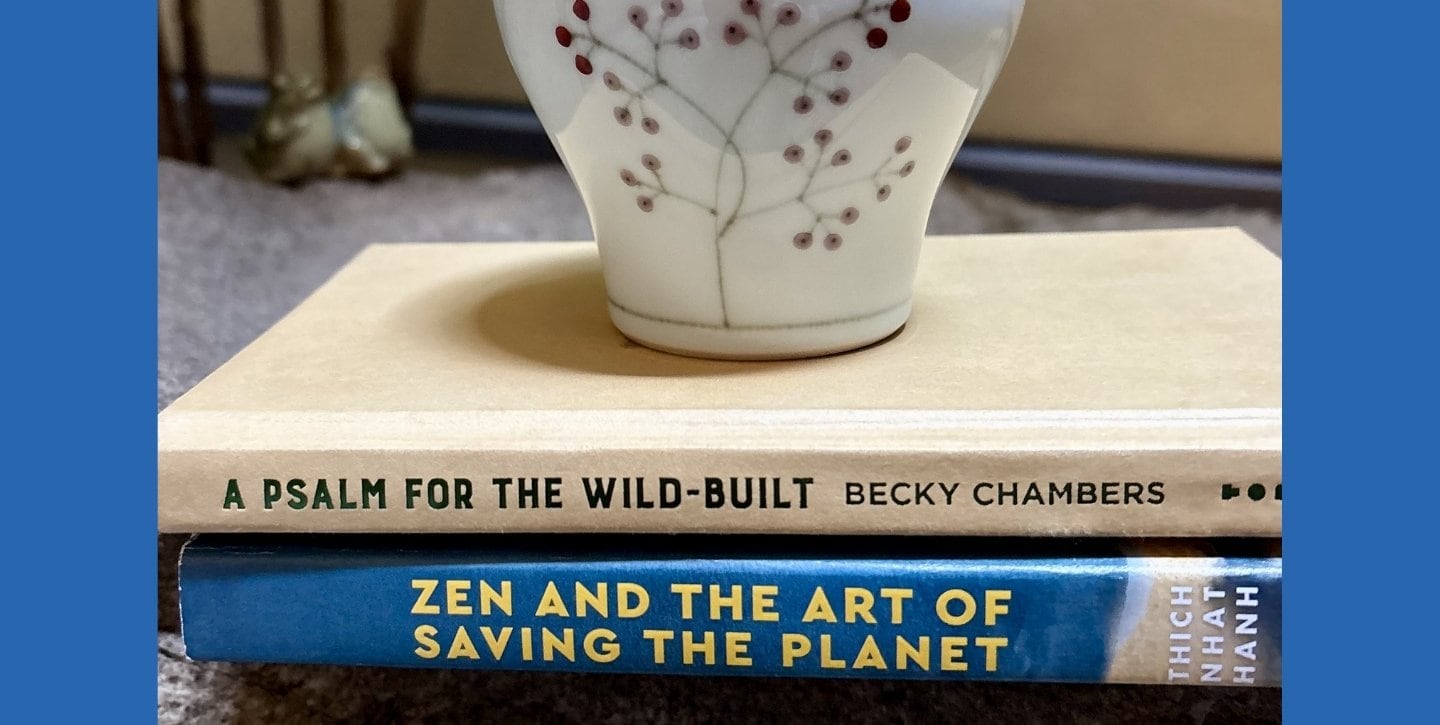
Lately, I’ve been seeking a new way of seeing this work and striving to find a better balance- one that moves away from the grind of “usefulness” and towards a more sustainable way of being deeply engaged with climate activism. I’ve found myself looking for answers in the conversation between a Tea Monk, a robot, and a Zen Master. Both A Psalm for the Wild-Built and the opening pages of Zen and the Art of Saving the Planet by Thich Nhat Hahn offer a quiet challenge: we must “find the strength to do both-“ to “wake up to the beauties of the planet to heal [ourselves] and wake up to the suffering of the world and try to help.”
A New Way of Seeing
To be transparent, I am only about twenty pages into Thich Nhat Hanh’s Zen and the Art of Saving the Planet. I’ve barely finished the first section of “Radical Insight: A New Way of Seeing” but even those few pages have begun to shift my mindset, and it has allowed me to see the central themes of A Psalm for the Wild-Built in a new light.
Thich Nhat Hanh writes that we must learn the “art of happiness” alongside the “art of suffering.” He suggests that we need to learn how to be truly present for life so we can get the nourishment and healing we need. On the other hand, we must learn the way to suffer, so we can suffer much less and help others do the same.
For a long time, I thought these two things were in competition. I felt that every moment spent “healing myself” or enjoying “the beauties” was a moment stolen from the movement. But Thich Nhat Hanh (and Becky Chambers) argue that this is a false choice. In fact, if we don’t do both, we’ll fail at both.
Comfort as Strength
This is where Becky Chambers’ story meets Thich Nhat Hanh’s philosophy. In A Psalm for the Wild-Built, Sibling Dex is a Tea Monk who wanders the countryside listening to people’s problems and offering a warm cup of tea and a moment of respite and comfort. Yet, Dex feels hollowed out by their own need to be “purposeful.” It is only through their friendship with a robot named Mosscap that Dex realizes that our value doesn’t have to be tied to our productivity.
Near the end of the novel (I promise this isn’t a spoiler), Sibling Dex recites the longer-form version of the “both” challenge from The Insights, the writings of the religion Sibling Dex follows:
“Without constructs, you will unravel few mysteries. Without knowledge of the mysteries, your constructs will fail. These pursuits are what make us, but without comfort, you will lack the strength to sustain either.”
While bearing witness to the atrocities occurring across the world, I sometimes feel guilt for the moments of joy and comfort I experience throughout the day. As if comfort is a luxury or even a distraction from the “real work” of policy and protest. But Chambers reframes comfort as essential infrastructure. Whether we are building the constructs of a new energy grid or trying to unravel the mysteries of how to live together on a changing planet, we simply cannot sustain the effort without comfort. Comfort is the fuel for the strength to do both.
Rooted Resilience
As we move through this Equinox, I am trying to practice this “new way of seeing.” I am trying to see my moments of joy, my cups of tea, and my time in the Michigan woods not as an escape from the reality of the world and my climate work, but as the very foundation of it.
To be a sustainable activist, we have to be resilient, rooted in the beauty of what we are trying to save, and strong enough to acknowledge the world’s pain without letting it break us. Comfort, joy, and happiness aren’t a distraction from the work; it is the only way the work gets done long-term.
I hope you’ll take a moment this week to find a bit of that “both.” Wake up to the beauty. Wake up to the help that is needed. And please, find the comfort you need to sustain your strength for the road ahead.
—————————————————————————————————
P.S. Join the Discussion: If these reflections on balance and the “strength to do both” resonate with you, I’d love for you to join our online book discussion for A Psalm for the Wild-Built on March 25th. It’s a quick read at 147 pages, but even if you haven’t finished it, you are welcome to join the conversation.
Register to Join the Discussion
Subscribe to The MiCAN Voice on Substack
Authored by