Resource
Line 5 Pipeline Facts
America’s most dangerous pipeline doesn’t only threaten the climate. It threatens water and communities along its entire length.

Line 5 Pipeline

About the Enbridge Line 5 Crude Oil Pipeline
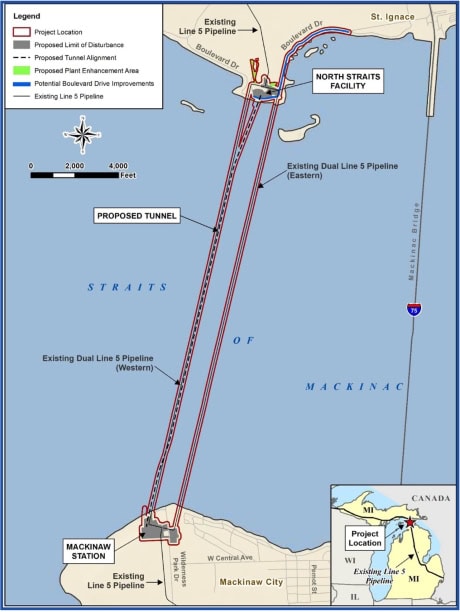 Every day, nearly 23 million gallons of oil flow through two aging pipelines in the heart of the Great Lakes, known as Line 5. Operating 21 years past its expected lifespan, this 645-mile pipeline runs from Alberta, Canada, to Sarnia, Ontario, cutting through Michigan and Wisconsin.
The Straits of Mackinac, where Line 5 runs 4.5 miles along the lakebed, is one of the worst possible places for an oil spill. The fast currents and extreme weather make cleanup nearly impossible. A spill could contaminate over 700 miles of shoreline, devastating ecosystems and treaty-protected fisheries. Federal agencies, including the EPA, U.S. Army Corps of Engineers, and the U.S. Coast Guard, have warned that existing resources are insufficient to contain a spill in the Straits.
Enbridge’s History of Oil Spills
Enbridge, the Canadian-based oil transport giant that owns Line 5, has a long record of environmental disasters. Its Line 3 and Line 6B pipelines caused two of the largest inland oil spills in U.S. history, releasing nearly 3 million gallons of oil into Midwest waterways.
Additionally, about one-third of the oil transported through Line 5 is refined at the Detroit Marathon Refinery, located in 48217, one of the most polluted zip codes in the country. This predominantly Black community has asthma rates 46% higher than the state average, with frequent air quality violations linked to increased cancer and respiratory diseases. Expanding fossil fuel infrastructure will only worsen these environmental injustices.
Watch this informative video to learn more about Enbridge’s spills and their devastating impacts.
MiCAN’s Work: Exposing Enbridge’s Climate Impact
MiCAN has been on the frontlines:
- Leading legal challenges against Enbridge’s tunnel permit alongside tribal nations and environmental groups.
- Mobilizing thousands of Michiganders to submit public comments, sign petitions, and pressure lawmakers.
- Fighting for climate justice, ensuring the voices of impacted communities, especially Indigenous nations and frontline Black and brown communities, are heard.
The Climate Cost of Line 5
- The tunnel project will lead to a net increase of 27 million metric tons of CO₂ emissions annually.
- Michigan has committed to 100% clean energy by 2040—yet new fossil fuel infrastructure directly contradicts these commitments.
- This report from the Institute for Energy, Economics, and Financial Analysis (IEEFA) shows that the Line 5 tunnel is not even in Enbridge’s financial interest.