March 13, 2026
Over the past year, rapid expansion of hyperscale data centers has come to dominate local conversations, and for good reason: taken together, proposed projects could increase the demand on the electrical grid, placing unprecedented pressure on local infrastructure and public resources. Furthermore, their buildout has been sudden, and often secretive.
In Saline Township, for example, a data center was fast-tracked by DTE Energy and approved by the Michigan Public Service Commission despite pushback from residents. In Lyon Township, nearby homeowners woke up to learn that a hyperscale data center had already been approved months earlier without a public hearing. A huge public response emerged, and it wasn’t just environmentalists taking data centers to task.
It was a broad coalition, reflecting how every Michigander pays an energy bill, and large-scale facilities threaten to drive rates significantly higher by adding massive new demand to the grid. Water is another shared concern. Michigan holds roughly one-fifth of the world’s surface freshwater in the Great Lakes, and communities rightly feel a responsibility to protect this for future generations. Energy costs and water security cut across political and ideological lines.
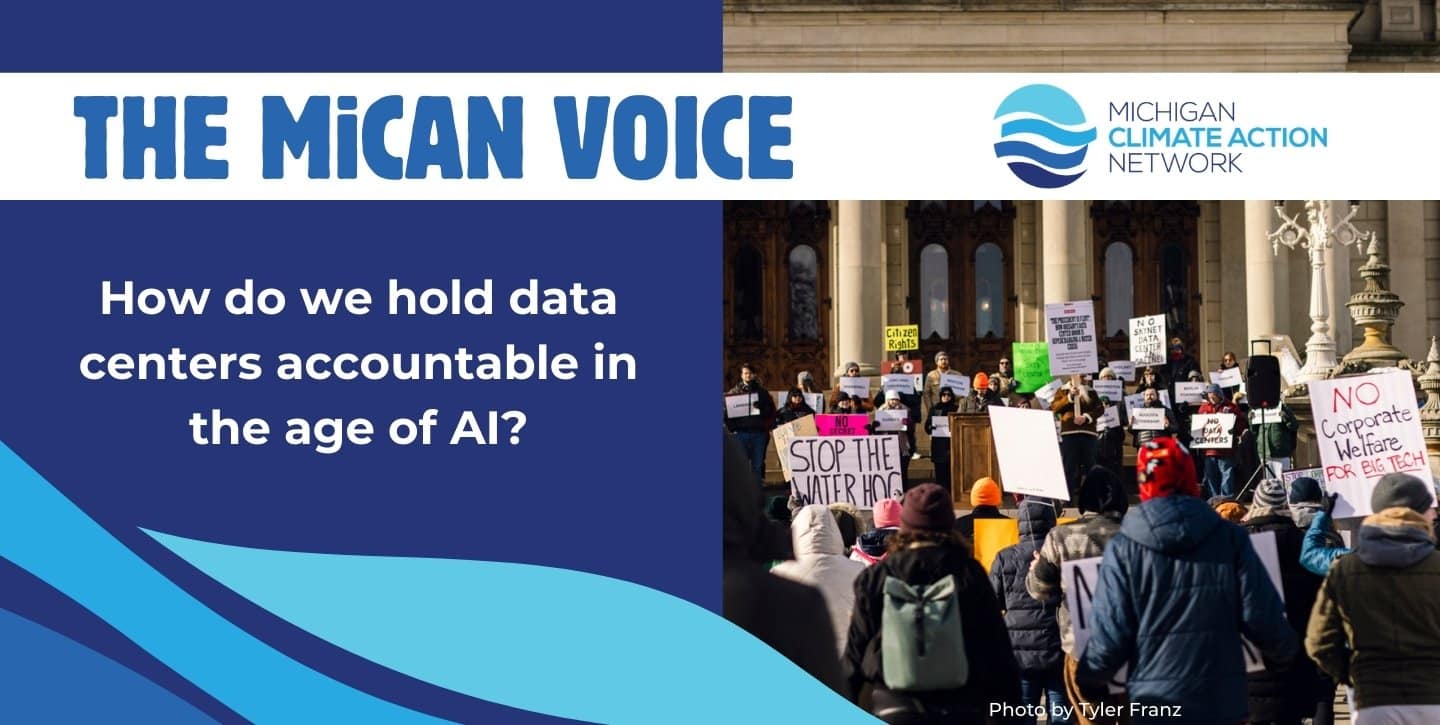
On the flipside, we’re also all consumers of data. The Michigan Climate Action Network has traveled across the state to engage communities on these issues and even livestreamed the Lansing rally opposing data centers to thousands of viewers using digital tools. As we’ve elevated the conversation, the feedback and questions we’ve received point to a critical, often unspoken challenge: how do we balance the need for data in our daily lives with policies and practices that ensure it is used responsibly?
Digital infrastructure is part of modern life. It’s important to be honest about the fact that data centers themselves are not inherently evil. We all rely on them. This very text is stored on servers in a data center, as is the code for the website on which it appears. The challenge, then, is not just heaping blanket opposition to data centers, but providing clarity about why these hyperscale facilities deserve closer scrutiny from a climate perspective—and how guardrails can provide a better path to regulate future forms of digital infrastructure.
To start, the core issue is scale. Many of these new facilities are being built to power artificial intelligence speculation. Companies are racing to construct far more capacity than current demand or profitability justifies. OpenAI is a company with an estimated $20 billion in revenue, but has pledged commitments to invest $1.4 trillion over the next eight years in data centers and computing (though it recently walked this number back to $600 billion). Unless the technology makes a sudden breakthrough, the size of the buildout is far too large for its likely future demand.
Each additional center built increases the risks of sitting underutilized in the long-term, while consuming enormous amounts of land and investment. In the short-term, investors burning through cash are training new models that will gobble up water and energy. In Michigan alone, proposed data centers would place enormous strain on a grid already trying to transition to renewable energy, while drawing heavily on water supplies to cool servers. In October 2025, Michigan utilities DTE and Consumers announced deals for 6.4 gigawatts of power for data centers. “This is equivalent to adding six or seven major cities to the grid in just two to three years,” according to Michigan Public Radio.
Another problem is that these companies provide very little information to the public in terms of the proposed impacts, and are largely able to get permission to build as long as local requirements are met. In some cases, these centers have brought in gas turbines or diesel generators to power the data centers, sending harmful pollution into nearby neighborhoods.
The climate movement has not been silent on this issue. In 2025, Senate Bills 671–673 and HB 5362, 5396, 5397, and 5399 attempted to undo damage caused by earlier legislation that granted generous tax breaks to data centers to attract them to Michigan. While these bills have not passed, they provide a useful blueprint for future guardrails, and how we could demand more from data centers. Among other things, they would have limited water withdrawals, required transparency around energy and water use, protected residents from bearing increased energy costs, and repealed tax incentives for data centers.
Additional safeguards should build on this framework. Hyperscale facilities should be required to operate on 100 percent renewable energy funded at their own expense, and to rigorously assess their impacts on local water sources. Some communities with data centers have already experienced altered groundwater composition due to large withdrawals, while others see data centers using municipal water, an extremely energy-intensive resource that is often simply evaporated in the cooling process. Finally, robust community protections and benefits should be added that transparently outline contributions to a community fund, hazard monitoring, or requirements for local labor.
Still, it’s important to keep the full picture in mind too. Data centers are not the most water-intensive activity in our nation. As AI-skeptic Hank Green has pointed out, corn—particularly corn grown for ethanol and livestock production—consumes roughly 20 trillion gallons in the United States alone. AI is estimated to consume about 260 billion gallons across the entire planet. Our lawns, if you’re curious, consume about three trillion gallons. This comparison highlights a deeper problem: we continue to behave as though we have limitless resources on a finite planet.
Hyperscale data centers are a symptom of the same extractive mindset that once fueled ethanol’s rise: an industry sustained by public subsidies and wasteful consumption, with serious long-term consequences for our energy and water supplies.
Fortunately, we still have time, and the power, to avoid repeating mistakes of that scale. Holding data centers accountable requires confidence in our ability to choose a smarter, more sustainable path. This isn’t a question of whether we need data; we do. It’s a question of whether we allow billionaires to compete with residents for water and energy for speculation, or whether we set clear limits to protect our communities. The choice is clear.
Since this article was published, new bills have been introduced proposing a year-long moratorium on data centers in Michigan. Take action today: send a letter to your elected representatives urging them to support this moratorium. It only takes two minutes to send a letter.
Share!
Subscribe to The MiCAN Voice on Substack
Authored by