May 8, 2026
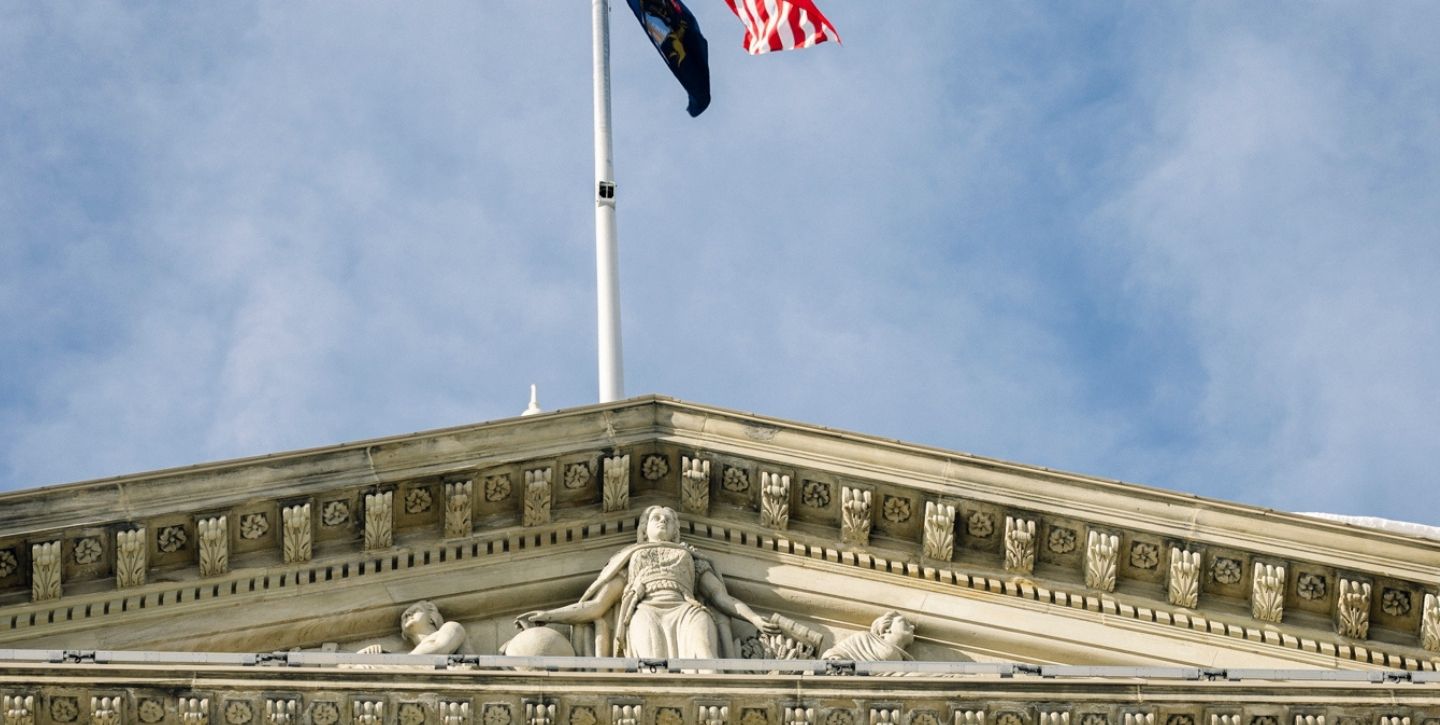
On Earth Day, we learned of the United States Supreme Court’s unanimous ruling, which denied Enbridge’s blushingly late attempt to move Michigan Attorney General Dana Nessel’s Line 5 case from state to federal court.
Michigan’s Solicitor General, Ann Sherman, who represented Dana Nessel, argued that the plaintiff chose the state forum because she’s a state official with state law claims, and the primary claim is public trust, and whether the easement is violating Michigan’s public trust doctrine.
Nessel also expressed the importance of trusting state courts to handle relevant issues impacting state lands, including state bottom lands in the Straits of Mackinac – regardless of whether they include federal questions.
As a long time shut down Line 5 advocate, I was truly moved to be listening in the Chamber while Sherman presented her case. Her arguments were undeniable to me, and to all nine Supreme Court Justices, apparently.
Line 5 Basics: Two Battles, One Struggle:
- The first battle concerns the fight over the continued operation of the existing, aging Line 5 dual pipelines, whose continued operation poses urgent freshwater security and energy independence threats.
- The second battle concerns Enbridge’s false solution to bore a massive, unprecedented tunnel under the Straits of Mackinac in order to house a new, unnecessary pipeline. This tunnel would lock in Line 5 infrastructure for another century and exacerbate our dependence on non-renewable, volatile fossil fuel markets. It would also infringe on Tribal Sovereignty, and affect only a four-mile segment of the line, leaving 641 miles of the dangerously aging Line 5 pipeline (with a serious spill record) as is.
How PHMSA Enables Enbridge Exploitation
The Pipeline And Hazardous Materials Safety Administration (PHMSA) federal agency has a track record of non-enforcement and reactivity instead of proactivity, according to a new report. This May 2026 report was prepared for The Great Lakes Business Network by the University Of Michigan Law School. Among other sobering points, this study reveals that PHMSA has never permanently shut down a pipeline, regardless of the magnitude or impact of the rupture.
“One of Enbridge’s most infamous pipelines, Line 5, has experienced 35 spills totaling over a million gallons of oil released along Line 5’s route, but PHMSA has never stepped in to order any shutdown orders, temporary or permanent. The only time that pipeline has been temporarily shutdown, it was the courts that required it.”
This does not bode well for future pipeline safety, especially when considering Enbridge’s abysmal track record. In short, Enbridge is responsible for two of the largest inland oil spills in the history of the United States: the Line 6B Kalamazoo River oil spill in 2010, and the Line 3 oil spill in Grand Rapids, Minnesota in 1991. There were also several serious aquifer breaches caused by Enbridge during the highly contested Line 3 expansion project in MN in 2022. The breaches caused groundwater to rise to the surface, violated state water rules, and posed a risk to sensitive wetlands.
What Does This Move Back To State Court Mean?
Since 2019, Nessel has been fighting to revoke the easement that allows the pipeline to cross the Straits, and decommission Line 5. This court win means that the case will return to state court where it belongs, and regain its original Nessel v. Enbridge title.
Importantly, this also means that the Sovereignty of all 12 federally recognized tribes in Michigan, who have been calling for Line 5 to be shut down, will hold more weight.
Before Nessel’s case can continue, the Sixth Circuit Court of Appeals will likely need to resolve a different Line 5 case regarding the appeal filed by Governor Whitmer and the DNR Director. The evolving timeline of this Sixth Circuit case means that both Whitmer and Nessel’s successors will play crucial roles in the outcome of this lawsuit.
Combating False Solutions and Misinformation
Shutting down Line 5 must become a high national priority. We agree with Trump that there is a “national energy emergency.” We just disagree on what it is and how to get out of it. A key question of our advocacy work is as follows:
How can Line 5 energy infrastructure be essential if it threatens affordability, energy independence, freshwater security, and our regional economy?
In the real world, Line 5 is far from essential. Line 5 is a colossal, outdated liability with a multibillion dollar spill risk in the Straits Of Mackinac. According to a FLOW commissioned report, a spill in the Straits could “trigger a domino effect of damage disrupting Great Lakes commercial shipping and steel production, slashing jobs, and shrinking the nation’s Gross Domestic Product by $45 billion after just 15 days.”
As noted on 05/01/26 in the New York TImes, there is a powerful new political coalition growing in Michigan and beyond. This coalition asserts that we do not need to let Big Tech companies build hyperscale AI data centers that are primarily for their benefit – and to our detriment. Similarly, we do not need to let Big Oil pretend that their outdated, unsafe way is the only way.
We do not have to settle for the type of non-renewable energy security that sacrifices our freshwater security, sabotages our MI Healthy Climate Plan, dooms us to more frequent and costly climate disasters, threatens Indigenous lifeways and cultural resources, and keeps us dependent on volatile fossil fuels. Especially when those false, non-renewable energy “solutions” are factually non-essential.
Is It Feasible to Decommission Line 5?
More than 70% of the oil in Line 5 is for Canadian markets, but Michigan incurs the risks. A 10/23 report from PLG Consulting, which does economic modeling for the oil industry, shows that the impact of shutting down Line 5 would be minimal, especially if the industry has a six months’ heads up to plan. There are plenty of other ways to get the oil and gas we use, while continuing to transition to renewable energy. A 2022 report authored by Martin Meyers of Meyers Energy Consulting, LLC similarly shows that supply and price disruptions related to a Line 5 shutdown would be manageable.
In terms of affordability for Michiganders, a comprehensive LEI study shows that a Line 5 shut down would amount to a temporary price increase of less than five cents per gallon. Enbridge’s own estimates show a price increase of about 0.5 cents – half a cent – per gallon of gas in Michigan if Line 5 is shut down. Gas prices are already fluctuating more than this from global oil markets.
We Michiganders are lucky that we do not rely on a single pipeline for propane. We need to continue to diversify our supply, improve storage and distribution, invest in efficiency to lower demand, and support the gradual transition from propane to more affordable, sustainable options like heat pumps and solar.
Line 5 Court Cases Summary:
If you’ve felt confused about what all is happening with Line 5, you are not alone. There are currently several lawsuits challenging Enbridge’s proposed tunnel project, and their continued operation of the aging Line 5 dual pipelines.
Here is a short summary of current Line 5 court cases and permits:
- The Sixth U.S. Circuit Court of Appeals case involving the State of Michigan, which has appealed a federal court ruling that barred Gov. Gretchen Whitmer’s administration from shutting down the Enbridge Line 5 oil pipeline beneath the Straits of Mackinac.
- The Nessel v. Enbridge case, which centers on Nessel’s efforts to revoke the 1953 easement that allows Line 5 to cross the Straits.
- The Michigan Supreme Court heard oral arguments on 3/11/26, where tribes and environmental groups (including MiCAN) challenged the permit issued to Enbridge by the Michigan Public Service Commission (MPSC) in 2023 to construct the pipeline and tunnel. The Michigan Supreme Court will ultimately decide on this appeal of the MPSC permit.
- This Wisconsin based legal battle in Iron County Circuit Court concerning the Bad River Band of Lake Superior Chippewa’s ongoing Line 5 struggle, as showcased in this Bad River film.
- Additional permit appeals may come down the pike here, too: U.S. Army Corps permits and (EGLE) permits.
The proposed Line 5 tunnel requires a clean water permit, and EGLE has the authority to deny permits that would harm water quality, threaten ecosystems, or perpetuate climate risks. The Straits Of Mackinac could become a 6 year, massive Line 5 tunnel construction site with risks of drilling fluid releases, explosions, and groundwater contamination – all while the old aging pipeline is still running. Don’t let the natural resources that define the culture and economy of northern Michigan be sacrificed for this risky project.
In sum, while we are heartened that Nessel’s case was moved back to state court, we have serious public pressure to build, and several legal cases to keep plugging away on. Now is the precise time to grow and educate our base in Michigan and beyond. 84 percent of North America’s available, fresh surface water – and the drinking water for 40 million people is at stake.
Share!
Subscribe to The MiCAN Voice on Substack
Authored by